NCC 2026 Speakers
| Photo | Name | Affiliation | Profile | Bio | Title | Abstract |
|---|---|---|---|---|---|---|
|
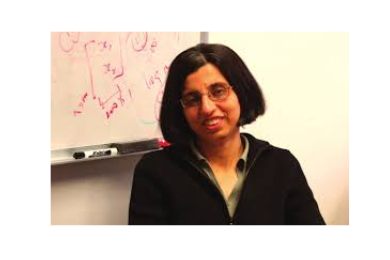
Namrata Vaswani | Iowa State University, USA | Profile |
Namrata Vaswani is a Professor of Electrical and Computer Engineering and the Anderlik Professor of
Engineering at Iowa State University. She also holds a courtesy professorship in the Department of
Mathematics. She received a Ph.D. in 2004 from the University of Maryland, College Park and a B.Tech. from
IIT Delhi in 1999. Her research is in statistical machine learning and signal processing, and in imaging
(MRI and video analytics). Vaswani is also the director of the CyMath K-12 math tutoring and support
program at Iowa State. She is a recipient of the IEEE Signal Processing Society (SPS) Best Paper Award (2014), the University of Maryland ECE Distinguished Alumni Award (2019), and the Iowa State Mid-Career Achievement in Research Award (2019). Vaswani is an AAAS Fellow (class of 2023) and an IEEE Fellow (class of 2019). |
Plenary Speaker |
Mathematical ML and ML for (better) Math: Alternating GD and Minimization (AltGDmin) for Secure
Federated Low Rank Matrix Learning and MRI, and Cy-Math This talk has two parts. First, I present our recent work on the AltGDmin algorithm for communication- efficient and fast distributed low rank matrix learning from "bad" data deliberately under-sampled (LR column-wise sensing), element-wise nonlinear (LR phase retrieval), missing (LR matrix completion), or outlier-corrupted (robust PCA and LRMC) data. These problems find important applications in LLM fine- tuning, recommender systems, and dynamic MRI. I also describe how to modify AltGDmin for efficient Byzantine-attack resilient LR learning. A key novel ingredient of this modification is a Byzantine-resilient federated PCA and subspace learning solution called "Subspace Median". In the second part, I discuss “ML for better K-12 Math,” highlighting how STEM professionals can help strengthen early math skills, especially for underserved students. I describe the CyMath program at ISU and how the use of ML-based math learning apps, like ALEKS, along with a STEM tutor can be a low-cost yet effective tutoring solution. |
|
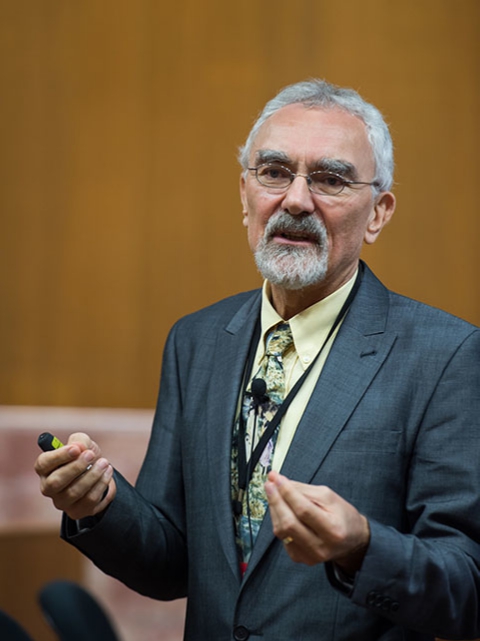
Lajos Hanzo | University of Southampton, UK | Profile | Lajos Hanzo is a Chair Professor of Telecommunications at the University of Southampton, UK. He has co-authored 20+ IEEE and IET books on wireless communications, published 2000+ research contributions at IEEE Xplore, and presented keynote lectures worldwide. He is a Fellow of the Royal Academy of Engineering, IEEE, IET, and EURASIP, and has received numerous awards including the IEEE Eric E. Sumner Technical Field Award. | Plenary Speaker |
Quantum Information Processing, Sensing and Communications: Their Myths, Realities and
Futures The recent advances in quantum information processing, sensing and communications are surveyed with the objective of identifying the associated knowledge gaps and formulating a roadmap for their future evolution. Since the operation of quantum systems is prone to the deleterious effects of decoherence, which manifests itself in terms of bit-flips, phase-flips or both, the pivotal subject of quantum error mitigation is reviewed both in the presence and absence of quantum coding. The state-of-the-art, knowledge gaps and future evolution of quantum machine learning are also discussed, followed by a brief discourse on quantum radar systems and briefly hypothesizing about the feasibility of integrated sensing and communications in the quantum domain. Finally, we conclude with a set of promising future research ideas in the field of ultimately secure quantum communications with the objective of harnessing ideas from the classical communications field. |
|
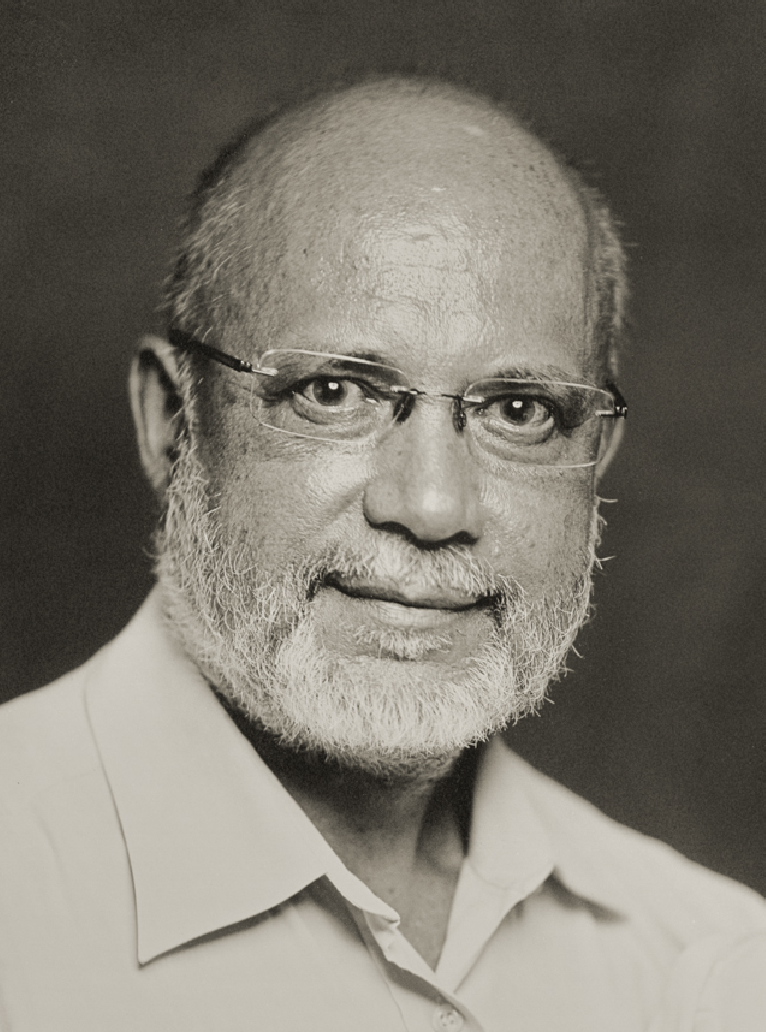
Francois Baccelli | INRIA and ENS, France | Profile | F. Baccelli is a senior researcher at INRIA-ENS, an invited professor at Telecom Paris, and a member of the French Academy of Sciences. His research is at the interface between applied mathematics and communication networks. His work on applied mathematics is focused on point processes, max plus algebras, network dynamics, stationary queuing networks, random graphs, and stochastic geometry. His main contributions to communications are centered on congestion control, information theory, and wireless networks. For his work on applied mathematics, he received the 2014 ACM Sigmetrics Achievement Award and the 2024 INFORMS Blackwell Award. For his work on communication networks, he received the 2002 France Télécom Award, as well as the 2014 Rice Prize and the 2014 Abraham Prize of the IEEE Communications Theory Society. He was the Math+X Simons chair in mathematics and ECE at UT Austin between 2012 and 2021. He just completed the interdisciplinary ERC advanced NEMO project on communications and network mathematics. | Plenary Speaker |
Stochastic Geometry and Dynamical System Analysis of Non-Terrestrial Networks based on Satellite
Constellations This lecture will be focused on broadband communication networks based Low or Medium Earth Orbit satellite constellations. It will first describe the structure of these constellations, their overall functionalities, as well as the economic and strategic context of their current deployment. It will then survey recent and ongoing results on the mathematical analysis of such networks. It will first show that the stochastic geometry framework for planar cellular networks can be extended to this new spherical geometry setting. This leads to a system level analysis of coverage and spectral efficiency of this new class of communication networks. In addition, it will show that a dynamical system analysis of this class of networks leads to new results on their ergodic or periodic behavior. The consequences on the dynamics of association, handover, and routing algorithms used in these networks will also be discussed. |
|
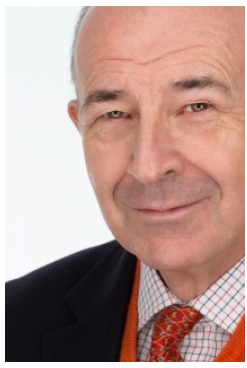
Erol Gelenbe | Institute of Theoretical and Applied Informatics, Polish Academy of Sciences (IITIS-PAN), Poland | Profile | Erol Gelenbe FIEEE'86 FACM'01 FIET'85 FIFIP'19 FRSS'20 is a Foreign Fellow of the Indian National Science Academy and a Professor at the Institute of Theoretical and Applied Informatics of the Polish Academy of Sciences. He earned his MS and PhD in Electrical Engineering from NYU Polytechnic Institute (1970), a State Doctorate in Mathematical Sciences from the Sorbonne (1973), and has supervised more than 90 PhD students. He is known for foundational contributions to computer and network performance modelling, including network protocols, and the invention of G-networks and the Random Neural Network. His career has included chaired professorships in Europe and the United States, and he is the recipient of several international recognitions, including the ACM SIGMETRICS Life-Time Achievement Award (2008), the Mustafa Prize (2017), the IEEE Technical Committee on Scalable Computing Excellence Award (2025), and Honoris Causa Doctorates from the University of Rome II, the University of Liège, Bogaziçi University Istanbul, and the Hungarian Academy of Sciences. He is also a Fellow of the French National Academy of Technologies, the Science Academy of Turkey, and Foreign Fellow of the Royal Academy of Belgium, and of the Hungarian and Polish Science Academies. | Keynote Speaker | Servers that provide access to the Internet of Things (IoT) must meet stringent security and Quality of Service (QoS) requirements, offering protection against cyberattacks with responsiveness and minimal loss of benign traffic. Therefore, protecting these systems through effective traffic smoothing, accurate detection of cyberattacks (AD), and mitigation mechanisms is essential. We will exhibit measurements of packet flows carrying a cyberattack that impair QoS at the server level and hinder its ability to perform AD. Using mathematical methods from queuing theory and experimental measurements, we demonstrate that the new QDTP traffic smoothing method that we have invented ensures that the server can provide effective AD and react quickly during an attack. We will then present online and federated machine learning techniques based on the Random Neural Network that we have invented, for accurately detecting attacks.A new Adaptive Attack Mitigation (AAM) system will also be presented to sample the flow of incoming packets, determine if an attack is in progress, and dynamically drop batches of packets at the ingress to reduce the effects of the attack and minimize AD overhead and the cost of lost benign packets. |
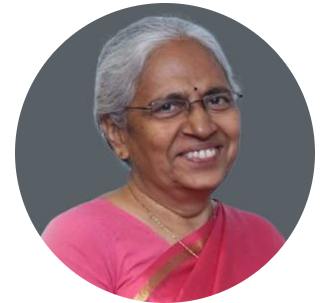
|
Jayanthi Sivaswamy | IIIT Hyderabad, India | Profile | Prof. Jayanthi Sivaswamy has been with IIIT Hyderabad since 2001. Trained as an Electrical Engineer, her research has been in the area of medical image computing by collaborating with several hospitals in India and abroad. Her work spans Computer Aided Diagnostics for various diseases affecting the eye, lungs, etc, explainability and incremental learning. Her recent work includes development of an Indian human brain atlas which received wide attention and VR-based solution for improving anatomy education. She has served on the research advisory council of SCTIMST, Tiruvananthapuram as well as committees of MICCAI, ISBI and ICASSP in various roles | Keynote Speaker |
Medical image time series processing Imaging to track changes over time either in an individual or a cohort is done for both clinical (to assess disease progress) and scientific (to understand temporal trajectory) purposes. Changes of interest can be over a short or an extended duration. This talk will begin by identifying challenges unique to processing image time series in the medical domain and discuss two problems: modelling and completing a time series with missing data, with a focus on neuroimages. Exemplars of these problems will be presented in detail: (i) modelling a time series of neuroimages where a different set of individuals are imaged at each time point, i.e. cross-sectional imaging; the goal here is to capture ageing-related morphological changes. (ii) imputing the missing volumes in a time series of an individual by learning from a set of incomplete time series of a cohort tracked over some duration, i.e. longitudinal imaging. |
Apart from this, we also have invited talks from industry and academia.